

Return to Harvester Part Dimensions and Compatibility
A worn cutting part can still support identification when measurements are taken from stable references and paired with machine, position and mating-part information.
Create a dimensioned identification record
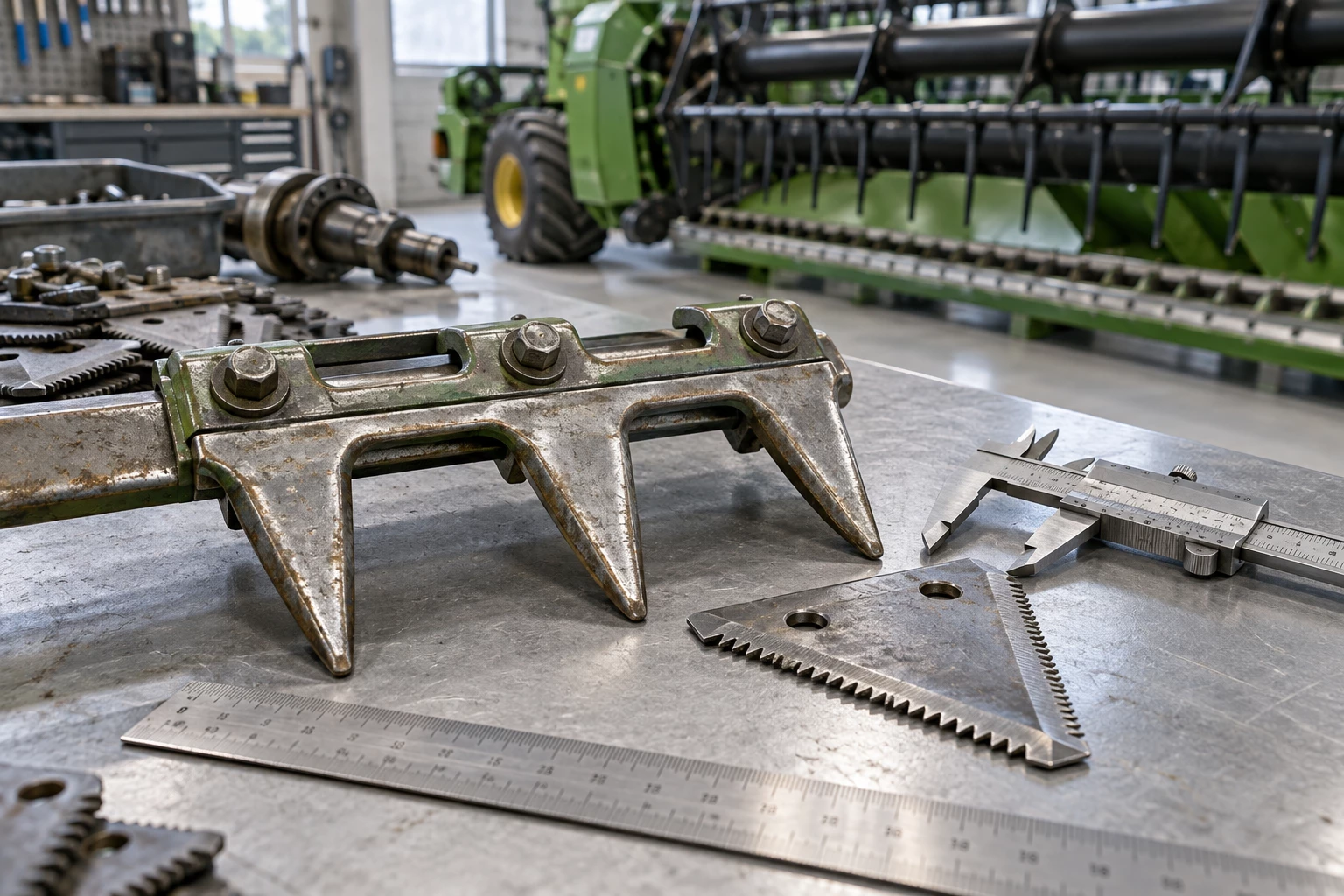
For how to measure a harvester knife guard or knife section, record each input with its unit, source and current status. Known values can be used immediately; unknown values should remain visible for confirmation instead of becoming silent quotation or production assumptions.
Use geometry, orientation and mating parts together
Photograph top, bottom, side and mounting faces
For harvester part dimensions and compatibility, connect this check to a drawing, measurement, photograph or acceptance note. Mark the remaining decision as open instead of allowing it to become an unstated quotation assumption. For this check, connect “Photograph top, bottom, side and mounting faces” to dimensioned sketch.
Use a dimensioned sketch with consistent units
Use stable datums, units and square-on photographs. Record worn or damaged surfaces so the measured sample is not automatically treated as the original production geometry. For this check, connect “Use a dimensioned sketch with consistent units” to scale-visible photos.
Flag surfaces visibly worn or deformed
For harvester part dimensions and compatibility, connect this check to a drawing, measurement, photograph or acceptance note. Mark the remaining decision as open instead of allowing it to become an unstated quotation assumption. For this check, connect “Flag surfaces visibly worn or deformed” to hole spacing and diameter.
Include markings and the adjacent mating part
For harvester part dimensions and compatibility, connect this check to a drawing, measurement, photograph or acceptance note. Mark the remaining decision as open instead of allowing it to become an unstated quotation assumption. For this check, connect “Include markings and the adjacent mating part” to overall length/width/height.
Where worn samples mislead measurement
- Measuring only overall length. Replace the shortcut with a visible assumption register for harvester part dimensions and compatibility. Confirm the unknown through the buyer, drawing, sample or agreed inspection method before release. Record the correction point against dimensioned sketch.
- Using a worn edge as the original datum. Replace the shortcut with a visible assumption register for harvester part dimensions and compatibility. Confirm the unknown through the buyer, drawing, sample or agreed inspection method before release. Record the correction point against scale-visible photos.
- Assuming the machine brand identifies one cutting system. Cross-check the reference with position, dimensions, orientation and mating parts. Mark wear or deformation so the supplied evidence is not mistaken for the original design. Record the correction point against hole spacing and diameter.
Freeze the approved replacement reference
Clean and label the sample.
Start with dimensioned sketch and scale-visible photos. Include the governing drawing, sample, equipment reference or application context that explains where the information came from.
Choose stable datums.
Separate confirmed values from open items, especially hole spacing and diameter and overall length/width/height. This allows an early review without turning missing information into guessed requirements.
Record dimensions and photos together.
Compare the route against hole centers and diameters and pitch and mounting pattern. Record why one option is being advanced and what evidence is still needed.
Compare against reference number and machine data.
Carry the same approved harvester part dimensions and compatibility revision, assumptions and acceptance criteria into quotation, sample review, production, inspection, packing and repeat orders.
RELIA can review the available information for how to measure a harvester knife guard or knife section, identify open items, and compare stock matching with custom production. Final product configuration and acceptance remain tied to the approved project information.
Send the current information for a project-specific review
You do not need to guess missing values before making contact about how to measure a harvester knife guard or knife section. Send the confirmed information and mark the remaining decisions for discussion.
